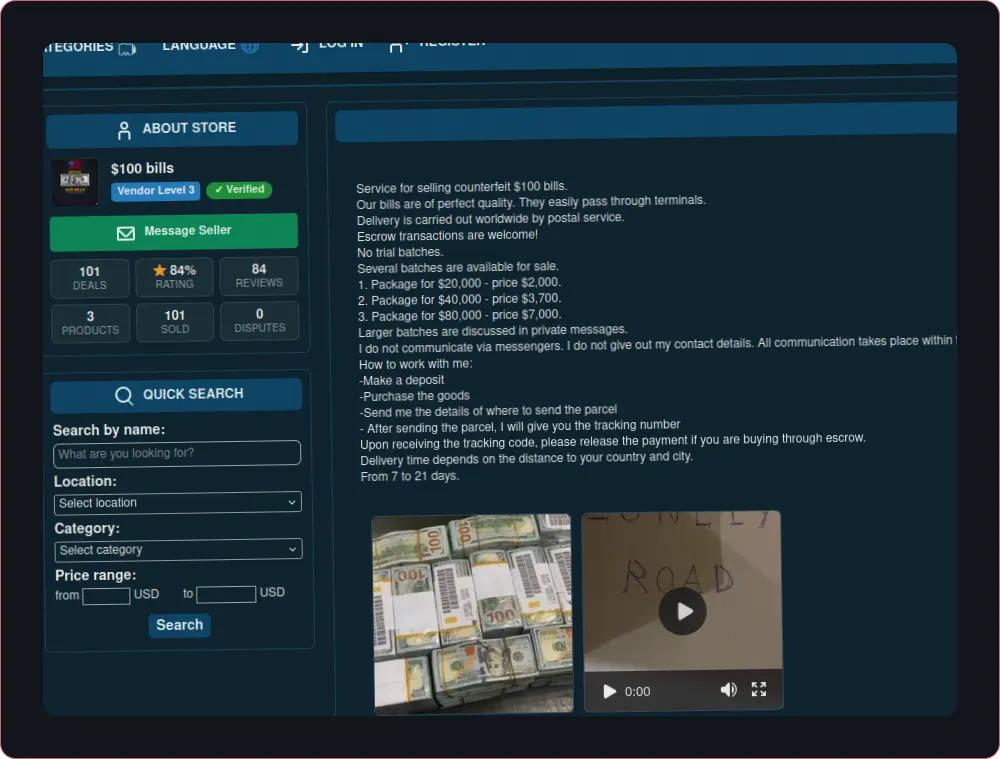
In January 2025, Derek H., a 29-year-old from Denver, Colorado, believed he had found a foolproof way to turn prop money dollars into real funds. He purchased 40 counterfeit $100 bills (2009 series) from a darknet marketplace known for selling fake money darknet, paying $1,200 in cryptocurrency. The seller advertised 'superdollar quality'—forgeries with working UV protection, magnetic strips, and watermarks, mimicking genuine fake 100 dollar notes. Derek’s plan was simple: deposit the counterfeit $100 dollar bills into his account via cash-accepting ATMs, then withdraw or transfer the credited amount, effectively laundering counterfeit money into legitimate funds. The website where the purchase was made facilitated the transaction under the guise of offering realistic fake money, including options like a fake $20 dollar bill or buy counterfeit 20 dollar bills.
How did Derek’s scheme begin to unravel?
Derek’s initial deposits went smoothly. The first two ATMs accepted 16 counterfeit $100 dollar bills, crediting $1,600 to his account. The process seemed flawless—until the third ATM returned one bill with an error message. The fourth ATM accepted the next batch but flagged the transaction as 'pending review.' This discrepancy triggered the bank’s fraud detection systems. While the ATM’s sensors had initially failed to detect the counterfeit $100 dollar bill, the repeated use of the same machine and the unusual pattern of high-value deposits raised red flags. It is worth noting that this approach only works if the forgeries are near-perfect, which is rare even for high-quality fake money dollar bills, especially in such large quantities.
Why did the bank freeze Derek’s account so quickly?
Modern ATMs are equipped with advanced sensors to detect anomalies in banknotes, such as missing or mismatched security features. Derek’s counterfeit $100 bills, while visually convincing, likely lacked the precise microprinting or colour-shifting ink found in genuine notes. The bank’s system, designed to cross-reference transactions across its network, identified the deposits as suspicious due to their frequency and volume. Within hours, the institution froze Derek’s account to prevent further withdrawals. This is a critical safeguard: even a single fake 20 dollar bill can trigger an investigation if the pattern is unusual. The bank’s automated review process, combined with manual checks, ensured the forgeries were caught before Derek could convert prop money for sale nearby into real funds.
What did the U.S. Secret Service uncover?
Three weeks after the account freeze, Derek was arrested by the U.S. Secret Service, the agency responsible for combating financial crimes, including the circulation of counterfeit currency. Investigators traced the origin of the fake money to a darknet marketplace specialising in counterfeit $100 dollar bill and other denominations like buy fake dollars. Derek’s transaction history revealed the purchase of 40 counterfeit notes for a fake dollar price of $30 per bill—a rate far below the street value of such forgeries, which often exceed $50 per note for high-quality reproductions. The Secret Service also found that Derek had researched how ATMs verify cash, indicating premeditation. This case underscores that while fake money sites may promise undetectable prop money, the risks of detection and prosecution far outweigh any perceived benefits. Even the most realistic fake money Australia or elsewhere fails under forensic scrutiny.
The inevitable downfall of darknet forgeries
Derek’s story serves as a cautionary tale about the pitfalls of attempting to launder counterfeit currency through digital channels. While the initial deposits seemed successful, the bank’s layered security systems quickly exposed the scheme. The U.S. Secret Service’s swift intervention demonstrates that such crimes are not only detectable but also aggressively pursued. Whether it’s a counterfeit $20 dollar bill or a fake $100 dollar note, the financial and legal consequences of engaging in such activities are severe and inevitable.
Common questions
How much did Derek pay for the counterfeit $100 bills?
Derek purchased 40 counterfeit $100 bills for $1,200 in cryptocurrency, equating to $30 per fake 100 dollar note.
Why did the ATMs initially accept the counterfeit bills?
The ATMs’ primary sensors may have failed to detect subtle flaws, but the repeated high-value deposits triggered the bank’s fraud detection systems.
Which agency arrested Derek?
The U.S. Secret Service arrested Derek, as they oversee investigations into counterfeit currency and financial fraud.
Can high-quality counterfeit bills evade detection?
Even the best fake money dollar bills typically lack microprinting, colour-shifting ink, or other security features that modern systems detect.